GrantStation Alternative: Engrant vs GrantStation
Is GrantStation showing you enough grants? Manual keyword searches across a limited database leave opportunities on the table. Engrant uses AI to find, evaluate, and rank grants for you automatically.
2-week free trial • No credit card required
Why Nonprofits Outgrow GrantStation
Only 9,000 funders in the database
GrantStation's curated database contains approximately 9,000 funders. In a real-world comparison test searching for youth homelessness funding, GrantStation returned just 11 matches.
"I was initially disappointed by the number of matches that were returned. In total, GrantStation brought up 11 matches."— Instrumentl vs GrantStation Teardown
Engrant alternative: AI searches the entire live web — never limited to a fixed database
Manual search with no AI matching
GrantStation requires you to manually select keywords, geographic filters, areas of interest, and funder types — then sift through raw results yourself. There's no intelligent matching or fit scoring.
Engrant alternative: Enter your org name → AI researches and evaluates grants for you
Geographic filtering stuck at state level
GrantStation only lets you filter by state — not county or city. In a test for a Chicago-based nonprofit, several results were for counties well outside the Chicagoland area.
"Because GrantStation does not allow for specificity of geographic scope beyond the state, a number of the results that came up were for counties outside of Cook County."— Instrumentl vs GrantStation Teardown
Engrant alternative: Engrant checks geographic eligibility at the county and city level
No fit scores, red flags, or competition insights
GrantStation shows you basic funder profiles with names, locations, and descriptions. You need to manually assess whether each grant is actually a good fit for your organization.
Engrant alternative: Every grant comes with a fit score, competition level, effort estimate, and red flags
Engrant vs GrantStation: Which Is Better?
A side-by-side comparison for nonprofit grant seekers in 2026
GrantStation is a solid budget option with useful educational resources. Here's how it compares to Engrant's AI-powered grant discovery:
Let AI do the searching — not your already-busy team
With GrantStation, you navigate separate databases (US Charitable, US Federal, US State Government, Canadian, International), select keywords from dropdown menus, choose geographic filters, and manually review each result. It's straightforward — but it's manual work.
Engrant works differently. Enter your organization name or website URL. Our AI researches your mission, programs, geography, and characteristics automatically. Within minutes, you're reviewing grants that actually fit — not setting up search parameters across multiple databases.
For solo development directors juggling fundraising, programs, and board management, eliminating manual research is game-changing.
That's it. AI does the rest.
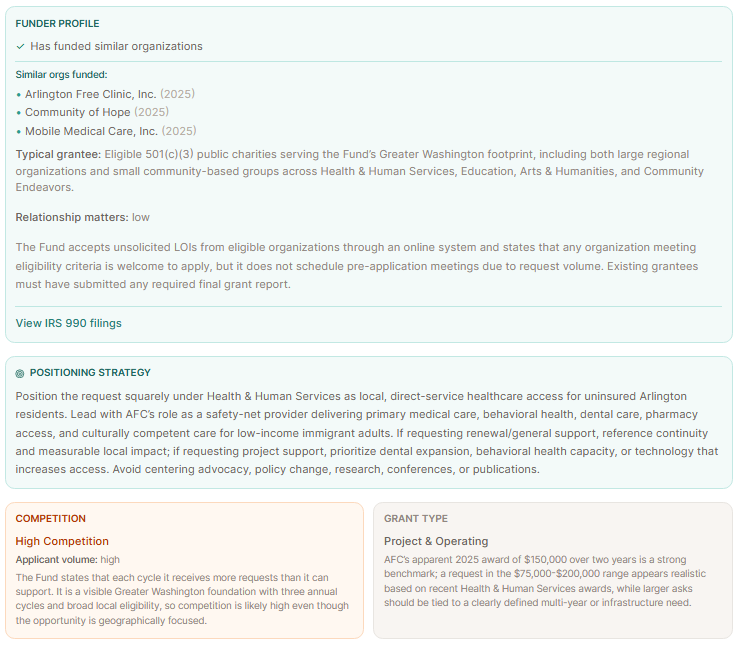
Every grant scored and evaluated — not just listed
GrantStation gives you funder names, locations, and brief descriptions. From there, you click into each profile to manually assess whether it's worth pursuing. That's how traditional databases work.
Engrant evaluates every grant before showing it to you. Each result comes with:
You save or reject each grant, and our system learns your preferences. No more clicking through funder profiles hoping to find a match.
Search the entire web — not just 9,000 funders
GrantStation curates a database of approximately 9,000 funders, focusing on active grantmakers. While curated quality matters, it means many opportunities are simply not in their system.
GSGrantStation
curated funders in a static database
11 results in a real-world test search
Engrant
AI searches the live internet for each query
30-50 pre-evaluated, high-fit grants per search
When a new RFP posts anywhere on the web, Engrant can find it immediately. With GrantStation, you're limited to what's in their curated database.
For time-sensitive grant deadlines, real-time discovery matters.
County and city-level matching — not just state
GrantStation's geographic filtering only goes to the state level. In a test for a Chicago-based nonprofit, this meant results for counties nowhere near Chicago — wasting time on irrelevant opportunities.
Engrant checks geographic eligibility at the county and city level, ensuring you only see grants you can actually apply for based on where you operate.
For nonprofits serving specific communities, geographic precision eliminates wasted research hours.
Watch how Engrant finds your grants
A quick walkthrough of how Engrant matches grants to your nonprofit — from start to results.
When GrantStation might be better vs. when Engrant is better
We believe in honest comparisons. Here's when each tool makes sense.
GSUse GrantStation if you:
- Have an extremely tight budget (under $200/year for grant tools)
- Prefer hands-on research and enjoy browsing funder profiles
- Want educational resources, webinars, and grant writing tutorials
- Need access to US Federal and State Government grant databases
- Are comfortable with manual keyword-based searching
- Want a supplementary tool to use alongside a primary grant platform
- Value the weekly GrantStation Insider newsletter for staying current
GrantStation's low price and educational resources make it a good starting point for nonprofits new to grant seeking.
Use Engrant if you:
- Are a solo development director who can't spend hours on manual searching
- Want AI to find and evaluate grants — not just list them
- Need fit scores, competition levels, and red flags for each grant
- Want geographic matching at the county/city level, not just state
- Are frustrated by databases that return too few or irrelevant results
- Need real-time discovery from the entire web, not a fixed database
- Value time savings — even if it costs more than a basic database
Engrant costs more than GrantStation — but the hours saved on manual research typically pay for the difference many times over.
Development professionals get it
I spend more time searching for grants than I do actually writing them, and half the ones I find don't even fit our mission.
Sarah, Development Director, $2.3M nonprofit
Engrant's AI is the best I've seen at identifying really aligned funders — quickly — no matter where in the world your organization works.
Shoshana Grossman-Crist, Funding Advisor
How Much Does GrantStation Cost?
GrantStation is budget-friendly. The question is whether the time you spend on manual research costs more than the price difference.
GrantStation
(~$17/month equivalent)
WHAT'S INCLUDED:
NOT INCLUDED:
Engrant
Or $37/month when billed annually ($444/year)
2-week free trial, no credit card
GrantStation costs less upfront (~$199/year vs $444/year). But if you spend 5+ hours/week on manual research, Engrant's AI-powered matching can save you 200+ hours per year — making the $245 difference a fraction of your time's value.
Common Questions About GrantStation Alternatives
Answers to help you choose the right grant discovery tool for your nonprofit.
GrantStation membership costs approximately $199/year. This provides access to their curated database of ~9,000 funders, manual keyword search tools, basic funder profiles, 990-PF data, and educational resources including webinars and their weekly GrantStation Insider newsletter. The membership is annual — there's no monthly payment option.
For nonprofits who want AI-powered grant discovery instead of manual database searching, Engrant is the leading GrantStation alternative. At $47/month, Engrant automatically researches your organization and delivers 30-50 pre-evaluated grants with fit scores, competition levels, and red flag warnings. Unlike GrantStation's manual keyword search, Engrant requires no search parameter setup — just enter your organization name and the AI does the rest.
GrantStation is a traditional grant database (~$199/year) with approximately 9,000 curated funders that you search manually using keywords and filters. It's supplemented with educational resources and webinars. Engrant ($47/month) is an AI-powered grant discovery tool that automatically researches your organization and delivers pre-evaluated grants with fit scores, competition levels, geographic precision to the county level, and red flag warnings. GrantStation saves you money; Engrant saves you time.
GrantStation can be worth it as a budget starting point (~$199/year), especially for nonprofits that are new to grant seeking and value the educational resources. However, in a real-world comparison test by a grant consultant, GrantStation returned only 11 matches for a specific search — and several were geographically irrelevant because GrantStation only filters by state, not county or city. For nonprofits with limited staff time, AI-powered tools like Engrant ($47/month) often deliver better results faster, despite the higher price.
GrantStation's database contains approximately 9,000 funders, curated across multiple databases including US Charitable, US Federal, US State Government, Canadian, and International. By comparison, larger platforms like Instrumentl claim 390,000+ funder profiles, and Engrant searches the entire live web rather than relying on a fixed database.
No. GrantStation uses traditional keyword and filter-based search. You manually select geographic scope, areas of interest, types of support, and funder types to generate results. There is no AI matching, fit scoring, competition level analysis, or automated eligibility screening. For AI-powered grant matching, alternatives include Engrant ($47/month) which automatically researches your organization and provides pre-evaluated results.
No. GrantStation's geographic filtering is limited to the state level. In a documented comparison test for a Chicago-based nonprofit, this limitation resulted in several irrelevant matches from counties far outside the Chicagoland area. Engrant offers county and city-level geographic matching, ensuring results are geographically relevant to where you operate.
Yes. Some nonprofits use GrantStation for its educational resources, government grant databases, and weekly GrantStation Insider newsletter, while using Engrant for AI-powered private foundation and grant discovery. GrantStation serves well as a supplementary educational resource, while Engrant handles the heavy lifting of finding and evaluating relevant funding opportunities.
Sources & References
Data and claims in this comparison are based on publicly available information from the following sources:
- [1]Instrumentl vs GrantStation Teardown — Detailed real-world comparison of GrantStation and Instrumentl by a grant writing consultant, including result counts and geographic filtering limitations
- [2]GrantStation Official Website — GrantStation's official platform with membership details, funder search, and educational resources
- [3]Instrumentl vs GrantStation Comparison — Detailed comparison showing GrantStation's ~9,000 funders vs Instrumentl's 390,000+ and feature differences
- [4]Grant Professionals Association: GrantStation Review — Professional association review of GrantStation's features and benefits for grant writers
- [5]SOAR: How to Use Grant Databases — Guide comparing GrantStation, GrantWatch, and Foundation Directory Online for nonprofits
- [6]Empower Change Consulting: Grant Platform Comparison — 2025 comparison of Instrumentl, Candid, and GrantStation for small nonprofits
- [7]TechSoup: How to Use GrantStation's Tools — TechSoup tutorial on using GrantStation's grant seeking tools and features
Last updated: February 2026. Pricing and features may change; verify current information on official websites.
Ready for grant discovery that does the work for you?
Stop manually searching through databases. Engrant uses AI to find, evaluate, and rank grants for your organization. Get 30-50 high-fit grants with fit scores, competition levels, and red flags — in minutes, not hours.