Find the funders you haven't heard of. Already vetted.
Engrant looks beyond whichever database you're using, then checks each funder against your mission — fit, eligibility, and red flags, done before you open a single funder site.
14-day free trial • No credit card required
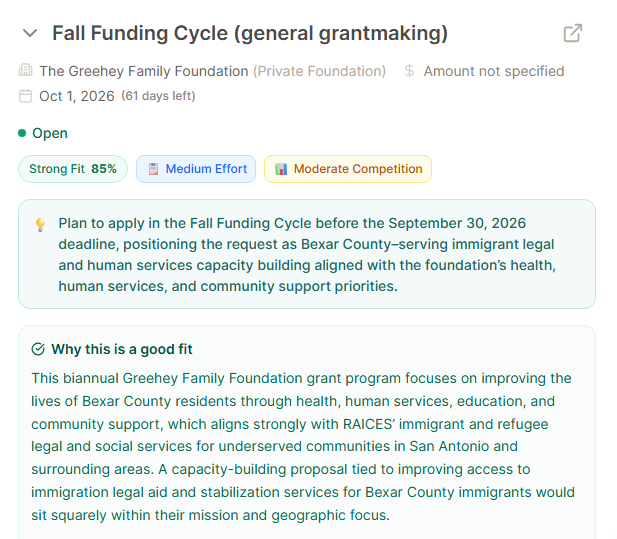
Grants our users found through Engrant
A sample of recent matches — embassy programmes, regional foundations, and corporate giving funds, across four continents.
Discovery in practice
A Costa Rican youth literacy nonprofit went from 5 actionable grants to 38 after one Engrant search — including embassy small-grants programmes from Canada, Switzerland, Australia, and Japan. That is the difference between filtering a database and searching the live web.
The money moved to funders no single database covers
In the US, federal grants are being frozen and cancelled. When the Center for Effective Philanthropy surveyed 585 nonprofit leaders in February 2025, 73% said changes in federal government funding were very likely to affect their work going forward — and 62% said it already was. (checked August 2026)
The money that's left is shifting toward private foundations, corporate giving programmes, and international and embassy funds. Those are scattered across thousands of funders that no single commercial database fully covers — and for anyone working outside the countries those databases were built for, they never were included in the first place.
Outside the US the shift is sharper still. Roughly half of USAID's funding used to flow through NGOs; the agency was permanently shut down in July 2025, and US foreign aid spending fell from $68 billion in 2024 to $32 billion in 2025 (checked August 2026). The UK, Germany and Canada announced cuts of their own. Organizations that were built on one or two large institutional funders are now looking for twenty small ones — most of which they've never heard of.
How Engrant Works
Describe the organization
Enter the nonprofit's name, website, or describe the mission in plain language. Engrant's AI researches the organization automatically — no lengthy intake forms.
Get pre-evaluated grants in minutes
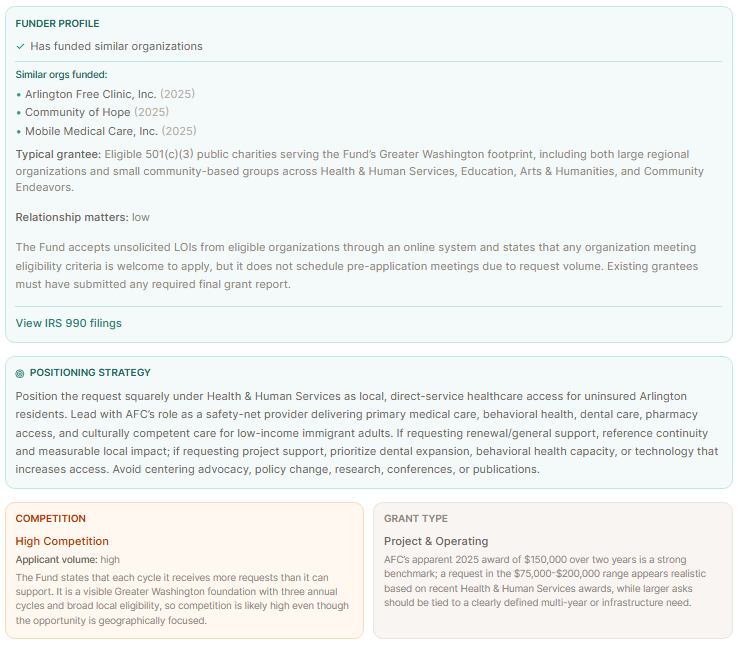
Engrant's AI searches across the web for grant opportunities matching the mission, geography, and capacity — then evaluates each one for fit, eligibility, competition, and effort. Not just keywords. Real analysis.
Save or reject with feedback
Keep grants worth pursuing. Reject ones that don't fit and tell us why—wrong geography, amount too large, need consortium partner. Your AI learns your real constraints.
See the full picture before you apply
Each grant comes with eligibility in plain English, estimated effort level, deadline, fit analysis — and critical considerations like payment schedules, competition levels, and potential red flags. The evaluation you'd do manually, already done.
Where the other options stop
Grant databases (Instrumentl, Candid, GrantStation)
Comprehensive within what they cover — but a funder they don't contain doesn't exist to you. Priced and built for teams with research staff.
Manual research (Google, funder sites, 990s)
Free, and bounded by how many funder sites you can personally open in a week.
General AI (ChatGPT, Gemini)
Fast and conversational — but it invents grants that don't exist, cites programmes that closed years ago, can't verify eligibility, and forgets everything about your client between sessions.
Engrant
Runs parallel search agents across the live web, so results aren't limited to what any one database covers — which is how embassy small-grants programmes, regional foundations, and corporate giving with no public application portal end up in results. Each one arrives pre-evaluated for fit, eligibility, competition, and red flags. Remembers each organization's constraints.
Everything after the search
- Pipeline events in your own calendar — expected call open, deadline, decision date and more, written to the calendar app you already use, with as many reminders as you want to set
- Proposal drafting help — a first draft grounded in the funder's actual stated requirements, to work from
- Unlimited organization profiles — each one learns its own constraints
- Monthly email updates on new funders matching your saved organizations
- Pipeline export
Watch how Engrant finds your grants
A quick walkthrough of how Engrant matches grants to your nonprofit — from start to results.
Built for people doing grant search without a research team
Unlimited searches and organizations. No per-seat pricing.
Both include:
14-day free trial • No credit card required
What our users are saying
Engrant does everything Instrumentl could do — but easier. I spend less time entering information and more time looking at grants that are actually a good fit, with effort and competitiveness ratings I never had before. It does more, at a better price.

I like that Engrant is comprehensive, smart, and quick. It saves me time by providing more than 100 grants, classifying them by fit, and giving me a full profile and analysis of how each grant aligns with my foundation just from its website link. I double-checked the information and analysis, and mostly it was right. When grant amounts are not published, it gives me an estimated amount, what I should ask for, and what words to use or avoid. It is very easy to set up, and I think anyone can use it.

Each grant breakdown covers exactly what I include in my funding strategies: eligibility, fit analysis, application steps, alignment considerations, and priority ranking - this was a huge benefit to see! The percentage ranking and "considerations" section mirror my own vetting process.

When I tried Engrant, I was honestly over . the . moon. ✨ Its AI is the best I've seen at identifying really aligned funders — quickly — no matter where in the world your organization works.

The fact that it searches online is crazy to me, because the amount of output it gave me is really comprehensive.

Other AI platforms give you outdated and inaccurate information; here EnGrant is always on point.

I am a premium member of Candid. But I never met this kind of tool. I've been through this for so many years, and what you did is what I was looking for.

I found two really strong grant opportunities that I wouldn't have found otherwise, and applied for one — the other I'll be applying for this week.

Questions? Answers.
Find the funders you don't know about yet
Enter the organization. Get funders that aren't in any database, each one already evaluated for fit, eligibility, and red flags.
Find my grants14-day free trial • No credit card required